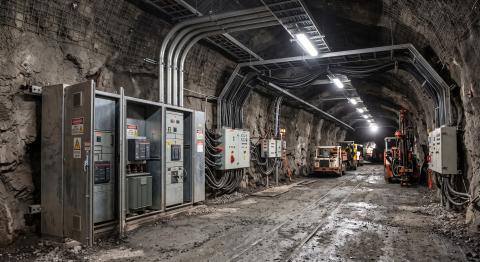
We build power centers and e houses for mines, so we hear about them most when something goes wrong. It might be a breaker that wouldn't trip, a lug that cooked itself black, or a protective relay that nobody had checked since the unit rolled off the delivery truck.
Almost every one of those calls could have been a line on a checklist instead.
So this is our take on electrical preventive maintenance, written the way we'd talk it through over the tailgate. It isn't a textbook, just what we've learned from designing and building this equipment and then getting the troubleshooting phone calls years later.
Key Takeaways
- A power center is built to take a beating.
- A power center can run fine for years with a relay that would never trip.
- First, lock out and test for absence of voltage.
The Equipment Is Tougher Than The Habits Around It
A power center is built to take a beating. It has a steel skid, a sealed enclosure and heavy cable couplers, and underground it gets dragged, bumped, dripped on and coated in dust while it keeps running.
That toughness is a trap, honestly.
Because it keeps running, people stop looking at it. The unit gets moved up the section, the cables get reconnected, and nobody opens the doors until a fault forces them to. By then a small problem has had months to grow into a big one.
Good electrical preventive maintenance is mostly about breaking that habit. You open the doors on a schedule, even when nothing seems wrong, and you write down what you see.
What The Federal Rules Expect
We're not lawyers, and your safety department is the final word here. But two rules come up constantly in our conversations with mine electricians.
Under 30 CFR 75.512, electric equipment has to be frequently examined, tested and properly maintained by a qualified person, and the results have to be recorded. Under 30 CFR 75.900-3, circuit breakers that protect low and medium voltage circuits need to be tested on a regular schedule, and that testing needs a record too.
Notice the pattern. Every requirement ends in a record.
That's not paperwork for its own sake. A record is how the next electrician knows what changed since the last visit.
Start Every Visit The Same Way
We like a fixed order. It keeps people from skipping steps when they're tired or rushed at the end of a long shift.
First, lock out and test for absence of voltage. Every time, no exceptions, even on a unit you "know" is dead.
Then look before you touch anything, opening the enclosure and studying it for a minute. Check for dust packed on the bus, water stains on the floor, the smell of overheated insulation, or discoloration on a terminal. Your eyes and nose will catch a surprising amount.
Only after that do you pick up a tool.

GET IN TOUCH
In a hurry? Call us at 276-285-3841
Connections Loosen. Plan For It.
Here's something we wish more people believed. Bolted connections in mining equipment loosen over time, and it isn't anyone's fault.
The unit gets moved, belts and cutters shake the ground around it, and loads swing up and down all shift, so the copper heats, cools and creeps a tiny bit with each cycle.
A loose joint has more resistance, resistance makes heat, and that heat makes the joint even looser. That loop can end in a burned lug or worse.
So check torque on main connections at the interval your manual gives, and after every move. Use a calibrated wrench. Mark the bolt with a paint pen once it's right, so a quick glance next time tells you if it has turned.
It's simple and inexpensive, and it prevents a lot of unplanned downtime.
Dust And Moisture
Coal and rock dust are conductive enough to cause trouble when they pile up on insulators and bus work. Add a little moisture and you've got a path for tracking.
Clean with a vacuum, not compressed air. Air just moves the dust somewhere else inside the box, often somewhere worse.
Look closely at door gaskets and cable entry seals, because a torn gasket is a small, inexpensive part that is usually the reason a clean enclosure becomes a dirty one.
Keep a few spares in the shop. You'll use them.
Test The Protection As Well As The Power
A power center can run fine for years with a relay that would never trip. You won't know until the day you need it.
That's why testing matters more than looking. Ground fault relays, ground check monitors, overcurrent relays and breaker trip units should all be tested against their settings. Check that each one actually opens the right breaker, rather than only checking that its light comes on.
Then compare the results with the previous test, since one reading tells you very little while a trend over several years tells you a lot. If a trip time is creeping longer each year, you've got an early warning.
Insulation resistance testing on cables and transformers works the same way. The number by itself matters less than whether it's dropping.
Infrared Scans Need Load
We're big fans of thermal imaging, with one catch.
A scan only finds hot spots when current is flowing. Scanning an idle unit on a down day mostly shows you a cold box. Plan the scan for a production shift, with the equipment carrying normal load.
Many mines scan two to four times a year. Dusty areas or heavily loaded units may need more. Save the images, because comparing this year's picture to last year's is where the value is.
Write It Down Before You Leave The Section
This is where good programs fall apart. The work gets done, but the notes get written from memory two days later, or never.
Fill out the record at the unit, including the date, who did the work, readings, torque checks, test results and anything that looked unusual, and attach a phone photo when it helps.
If you found a problem you couldn't fix, tag it and make sure the next shift knows about it, because a note left in a pickup truck doesn't count.

GET IN TOUCH
In a hurry? Call us at 276-285-3841
How We Can Help
When we build a unit, we know every relay, breaker and connection inside it. That makes us a good partner when you're setting up your electrical preventive maintenance schedule, or when you're trying to figure out why a unit keeps acting up.
We can't run your program for you. Your qualified people do that. But we can help you build a plan that fits the equipment you actually have.
For more, see Becker Mining transformers, e house designs, how ground fault systems detect faults and electrical distribution equipment for underground mines.
Need Help Planning?
Call Becker Mining at 276-285-3841 or contact our team. We can help you build a maintenance plan around your Becker equipment.
Frequently Asked Questions
Q: How often should an e house get an infrared scan?
A: Many mines scan quarterly or twice a year, under load. Dusty or heavily loaded areas may need scans more often.
Q: Should relay testing be part of electrical preventive maintenance?
A: Yes. Testing confirms each relay trips at the right setting and signals the right breaker when a fault happens.
Products We Offer:
- Explosion Proof Equipment
- Transformers
- Arc Guard
- Longwall Electrical Systems
- Capacitor Trip Devices
- Electrical Equipments like capacitor banks, switch houses, junctions, and splice boxes.
Power up your productivity with Becker Mining's ground fault relays - the reliable and efficient solution for all your power distribution needs. Call us today!